
Off-leash Areas

By designating specific parks and trails as off-leash areas, the City prioritizes the safety, predictability and clarity for all trail users to enjoy our shared outdoor spaces.

Off-leash spaces

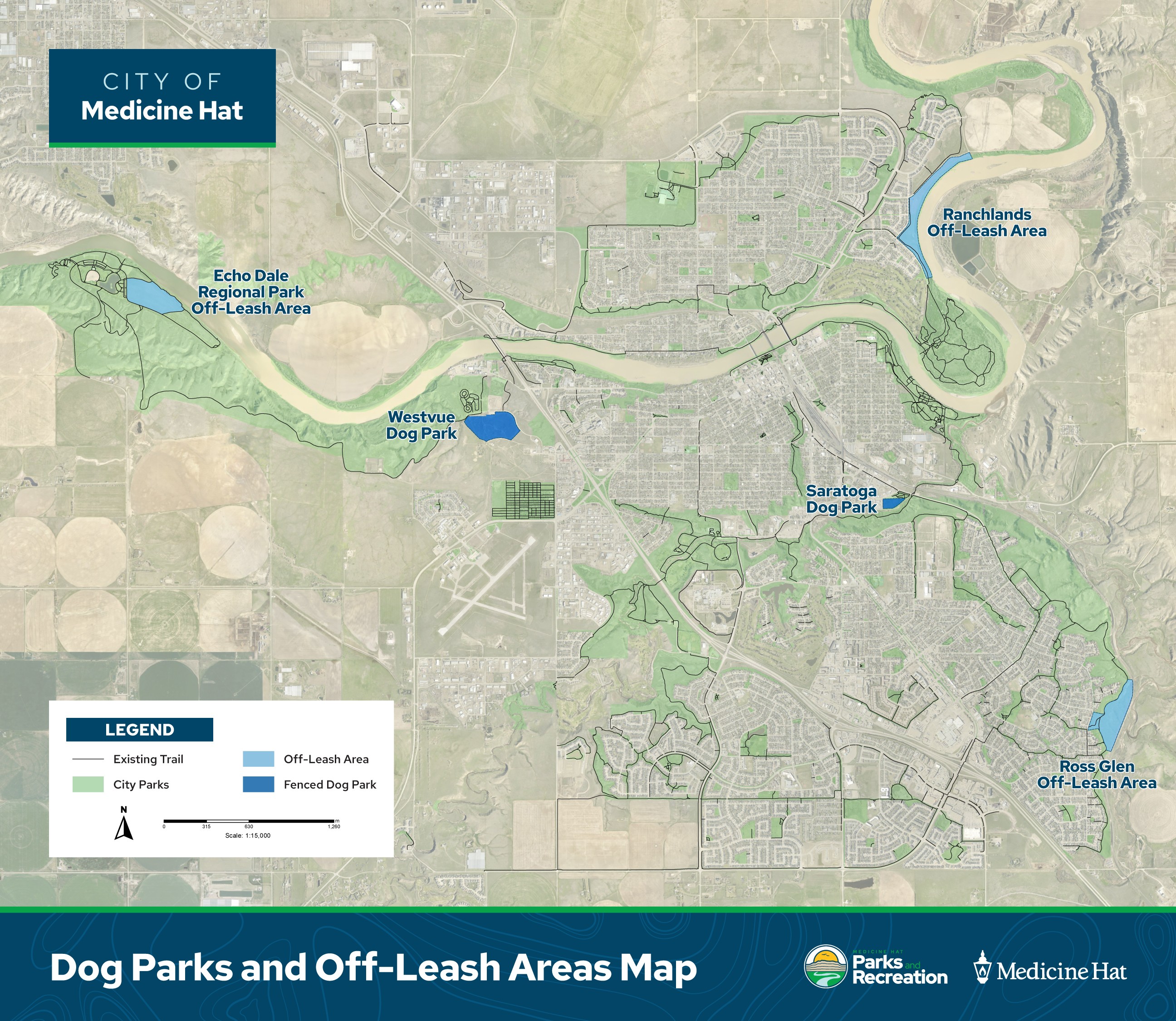
Medicine Hat has five dedicated off-leash areas - two fenced dog parks and three unfenced spaces.

Fenced dog parks (learn more)

  • Saratoga Dog Park (2.1 hectares)
  • Westvue Dog Park (14.7 hectares)

Unfenced off-leash spaces

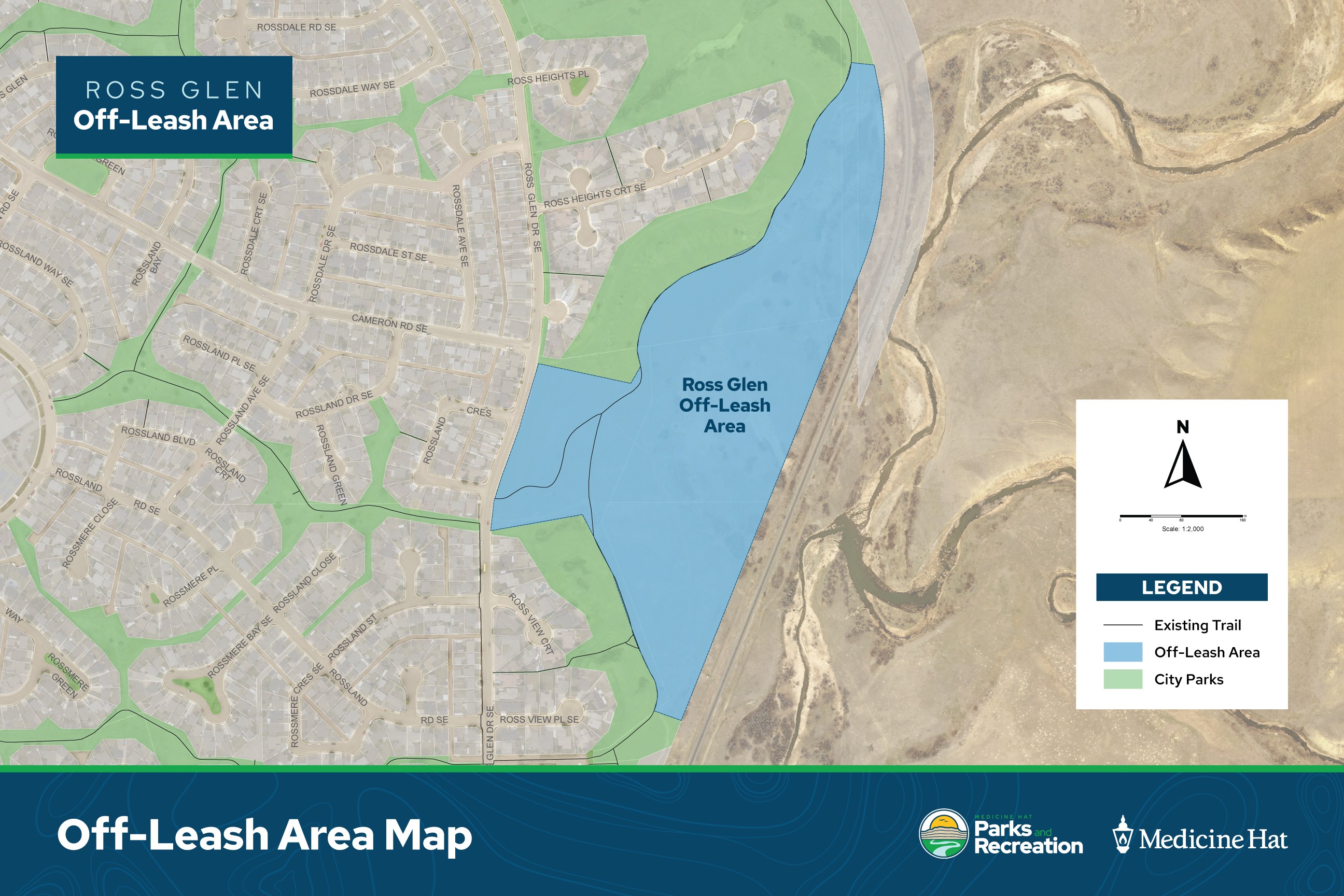
  • Ross Glen natural area (14.8 hectares)
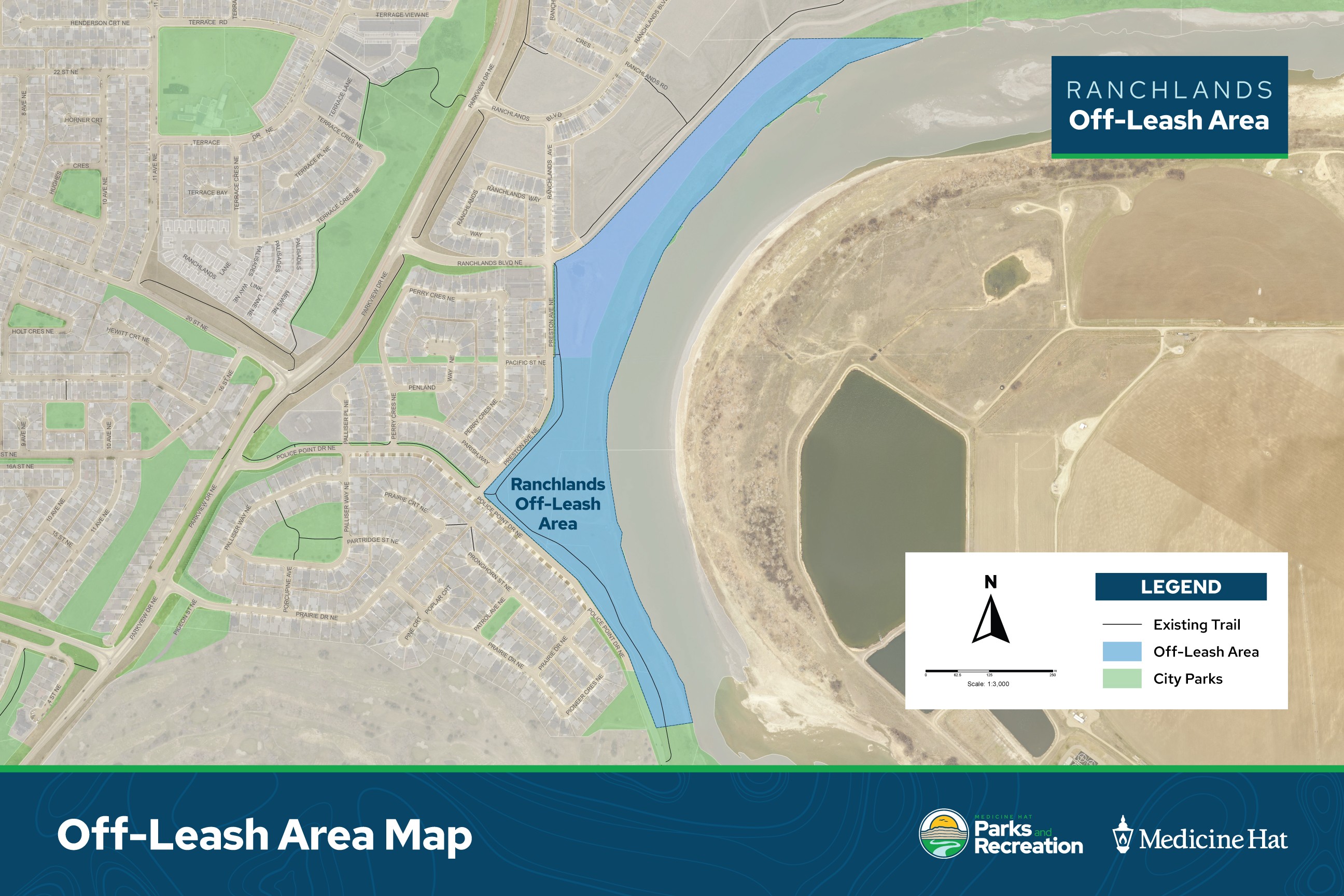
  • Ranchlands / Parkview (19.4 hectares)
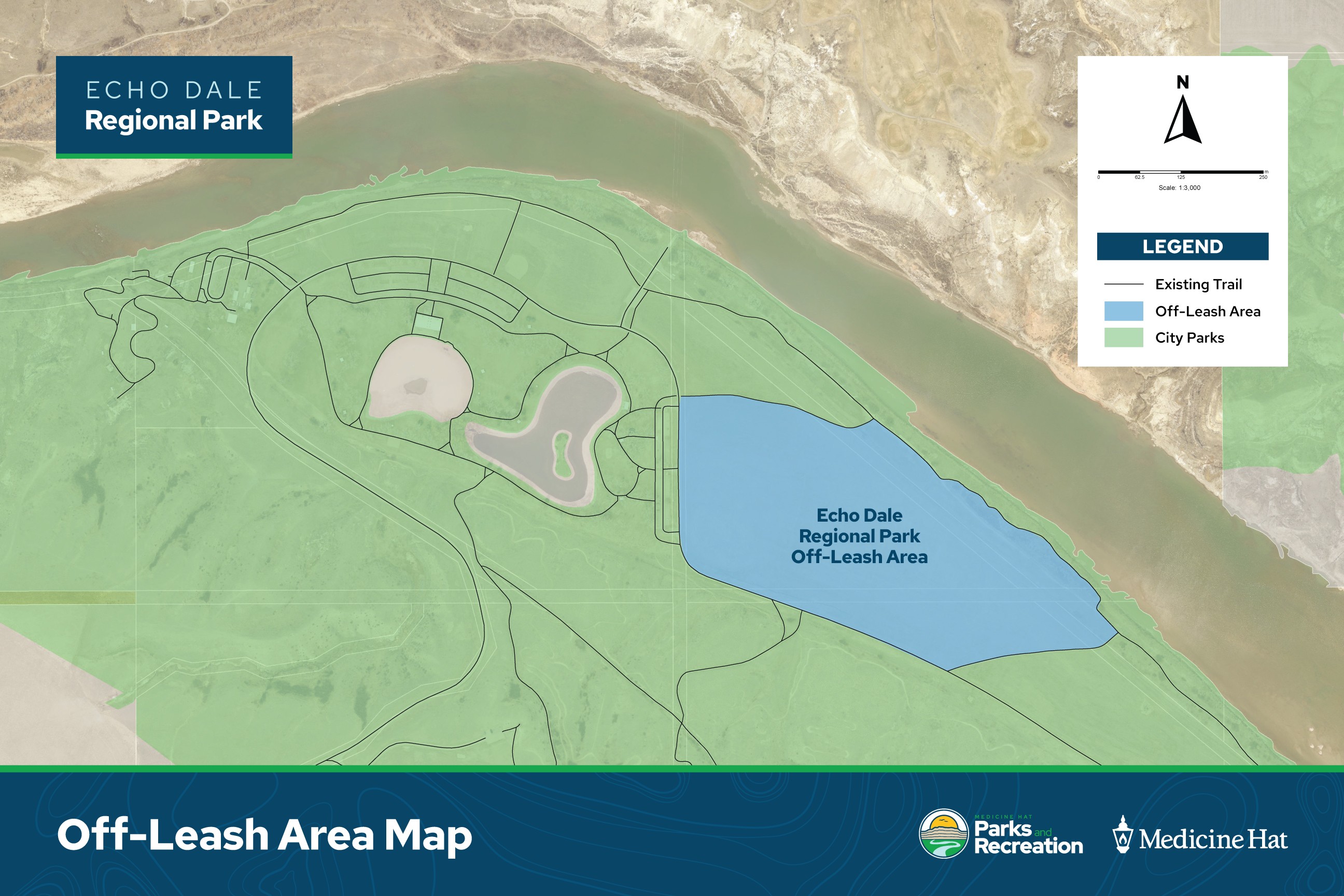
  • Echo Dale Regional Park (16.2 hectares)

These off-leash areas total 67.2 hectares of functional, easily accessible space. Medicine Hat now has a ratio of approximately 9.8 hectares of off-leash space per 10,000 residents. This quantity is above average for municipalities.

Maps of off-leash trails

The City of Medicine Hat has allocated three sections of trail as off-leash areas. 

These spaces were identified based on their suitability and current popularity to ensure safe use for all. They are wide open with many access points and good site lines. This allows for a more predictable experience and assists in reducing the chance of high-risk incidents caused by unexpected encounters.

These areas are all easy for residents to access and navigate, and are clearly delineated with signage.


In order to prioritize safety and predictability, the City of Medicine Hat has designated all other parks, trails and open spaces as on-leash.


Enforcement of off-leash areas falls under Bylaw No. 3935, the Responsible Animal Ownership Bylaw.

FAQs

The City of Medicine Hat's existing off-leash areas came into effect on September 8, 2026. Learn more about the decision, and what to expect moving forward.

What led to the decision

Staff conducted extensive public engagement over the last five years to better understand community perspectives. The primary engagement was an Off-Leash Area Review initiative in 2022. A What We Heard Report highlights the engagement efforts within the review, and key themes emerging from public feedback.

Residents indicated a need for more clarity on which spaces are on and off-leash, maps, enforcement, and what to expect when entering on and off-leash areas.

Survey feedback indicated a nearly split view on the future of off-leash areas in Medicine Hat – these were questions posed during specific off leash engagements and general outdoor enjoyment engagements. Discussions occurred on the possibility for the City to maintain, expand, reduce, or eliminate off-leash access.

It's important to note:

  1. The survey was one element of the City’s lengthy public engagement process; and,
  2. Public engagement was one element of what factored into changing off-leash areas.

View the Public safety section below to learn more.

The City of Medicine Hat has an obligation to protect its residents and all users of the extensive network of parks, trails, and open spaces.

Residents have stated they want to feel safe when using trails, parks and open spaces. There has been a reported decrease in trail use due to the unpredictability of off-leash animals.

Critical public safety concerns will always be the priority to address, especially in instances with split public sentiment.

Conversations with residents, service requests, public inquiries and complaints uncovered instances of significant harm and safety concerns for trail users. These instances involving off-leash dogs included, but were not limited to the following:

  • Severe, life-threatening bite to the neck of a resident
  • Youth knocked over and leg broken by dog chasing a ball on trail
  • Chased or bitten while walking or running on or near trail
  • Other dogs attacked, chased or bitten (on and off-leash)
  • Repeated urination on a mobility aid
  • General discomfort and/or fear of dogs by residents with varied age, ability/mobility, history, etc.
  • Wildlife attacked by dogs

By the numbers

Between January 1, 2021, and April 21, 2026, Bylaw Services recorded 207 calls for service related to dog bites or chases, including 90 incidents involving dogs that were off-leash or at large. While not every incident results in enforcement action, and some incidents go unreported, this information helped inform decisions regarding off-leash areas.

Engagement also uncovered that residents often underreport incidents. This may be due to difficulty enforcing, providing more than verbal proof, lack of resolve, etc. The number and severity of incidents is likely higher than the number indicated through recorded service requests and Medicine Hat Police Service statistics.

This change to off-leash areas addresses and errs on the side of public safety.

These off-leash area adjustments are part of a broader strategy to promote outdoor enjoyment and ensure safety on trails, parks, and other open spaces around the community.

Two common questions arose from public feedback and commentary since the implementation of these off-leash changes: 

  • “Why are dog owners being singled out?”
  • “If it’s about trail safety, why not address e-bike and e-scooter use?”

The City and Medicine Hat Police Service are aware of the safety concerns brought on by e-bikes and e-scooters, as well as electric motorcycles (often mistaken as e-bikes).

The City acknowledges there are multiple trail safety concerns that will need to be addressed, and unfortunately, these concerns can't be broadly addressed at once with a single change.

Each may need to be addressed separately for the greatest effect.

While these off-leash area changes aim to improve the predictiability and safety of all users, the City is committed to work with Bylaw Services to develop a strategy for enforcement of e-bike, e-scooter and other electric modes of transportation.


How these spaces were chosen

Staff used the following factors as criteria to determine and designate off-leash areas: 

  • Clear and discernable boundaries 
  • Appropriate signage identifying the designated area 
  • Relative separation from residential and commercial properties 
  • Consideration of ecological factors
  • Larger usable land pieces and good sight lines 
  • Availability of parking  

Based on the Off-leash Area Review, some locations were found to align more closely with the criteria than others.

Section 15(1) of Bylaw 3935, the Responsible Animal Ownership Bylaw, indicates that City administration may designate off-leash areas.

Changes to off-leash areas do not require changes to the Bylaw - therefore, City Council is not legislated to make this decision.

How Medicine Hat compares

Medicine Hat has 67.2 hectares of off-leash space – a ratio of approximately 9.8 hectares per 10,000 residents. This number is above average among comparable municipalities.

Designated off-leash areas are common amenities in cities. However, the types of spaces that are offered can vary. Some cities have fully fenced off-leash areas, and some have a combination of areas that are fenced and unfenced.

The City of Medicine Hat has chosen a balanced approach of fenced and unfenced off-leash areas to ensure the needs of all trail users are met.

Comparable municipalities like Calgary and Edmonton have used comprehensive, system-wide reviews rather than evaluating off-leash sites individually. Calgary’s approach considers site function, size, surrounding recreation uses, safety and service levels, while Edmonton’s strategy evaluates access, site use, environmental impacts, safety, amenities, maintenance and geographic gaps in off-leash opportunities.

Medicine Hat's approach to reviewing off-leash areas included an overview of sites, assessing potential options with the following criteria:

  • Clear and discernable boundaries
  • Appropriate signage identifying the designated area
  • Relative separation from residential and commercial properties
  • Consideration of ecological factors
  • Larger usable land pieces and good sight lines
  • Availability of parking  

Staff also ensured the total space of these suitable off-leash areas produced an above average ratio of hectares per 10,000 residents - an industry-standard metric. Medicine Hat's ratio of 9.8 hectares per 10,000 residents is above average among comparable municipalities.

Feedback on the City's off-leash areas may be submitted through the off-leash feedback form.

Trail etiquette

In Medicine Hat, we share our trails with all users.

Keep dogs within view at all times. Stay aware of your surroundings and make sure that you can hear others. Avoid using smart phones and keep the volume low. Be aware of other trail users.

Look both ways before entering a pathway. Be sure the trail is clear of obstructions and watch for slippery sections covered by ice, loose gravel or silt. Always remember to watch for wildlife.

Pick-up after your pet and consider keeping your dog on-leash, even on off-leash trails. Not everyone is comfortable with other pets.

Remember to stay to the right side of the trail. Keep to the pathways as much as possible to protect wildlife and habitat. Please do not disturb or feed any wildlife.

Dogs in heat are not permitted in off-leash areas. Stick to on-leash paths during this time.

For everyone's enjoyment of our trails, dogs must be under the control of an adult and respond to verbal commands in off-leash areas. 

Call out to other trail users, and slow down before passing on the left-hand side.

Dogs using off-leash areas must be licensed and vaccinated to help keep all pets healthy. 

If your dog likes to dig, be sure to fill in any holes they make. Dog owners are responsible for any damage or injury caused by their pet.

To protect their paws, glass containers are not permitted on off-leash trails.

Parks

88 Kipling Street SE
Medicine Hat, Alberta
T1A 1Y3
P: 403-529-8333
F: 403-529-8254
Email us

Recreation

2000 Division Ave N
Medicine Hat, Alberta
T1C 1X9
403-502-8566
Email us


The City of Medicine Hat acknowledges that we live and work on treaty territory. The City pays respect to all Indigenous Peoples and honours their past, present and future. We recognize and respect their cultural heritages and relationships to the land. Medicine Hat is situated on Treaty 7 and neighbour to Treaty 4 territory, traditional lands of the Siksika (Blackfoot), Kainai (Blood), Piikani (Peigan), Stoney Nakoda, and Tsuut’ina (Sarcee) as well as the Cree, Sioux, and the Saulteaux bands of the Ojibwa peoples, and homelands of the Métis Nation District 2 Battle River Territory. Learn more.